Here's the short answer: a smoke curtain is never required by code.
That's not a technicality. It's an important distinction that shapes how architects, engineers, and building owners should be thinking about this question from the start. What the code requires is elevator smoke protection. A smoke curtain is one way to provide it. It's not the only way, and the code doesn't mandate it by name.
So the better question, the one worth actually answering, is: WHEN is elevator smoke protection required?
Start with IBC Chapter 30
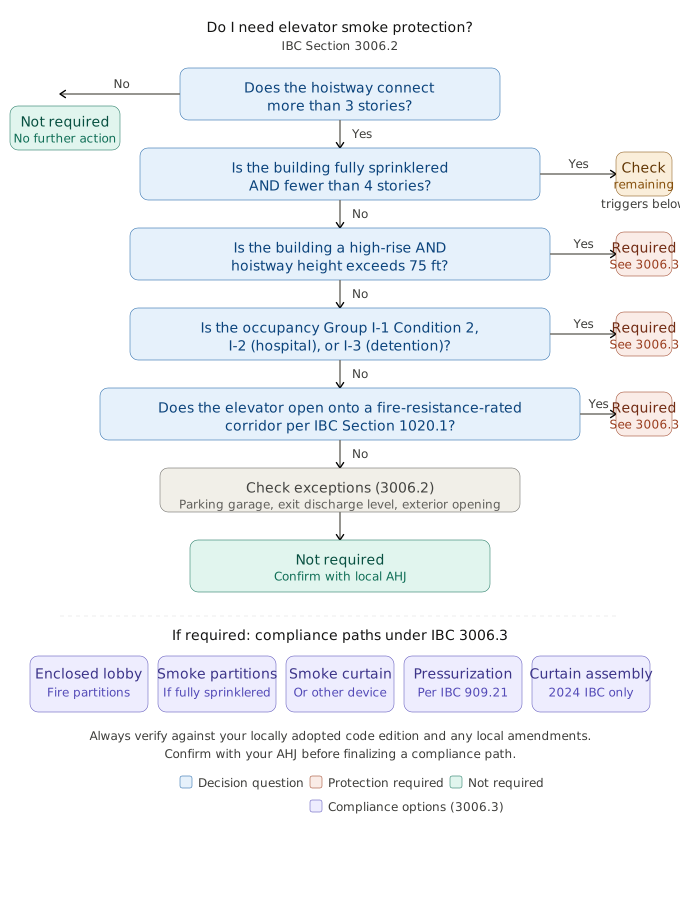
Elevator smoke protection is addressed in Section 3006.2 of the International Building Code. It applies when an elevator hoistway connects more than three stories and at least one of the following conditions is present.
The Three Triggers
The building is not fully sprinklered and the building is above the established height thresholds.
If the building isn't protected throughout by an automatic sprinkler system and it's four stories or more, elevator smoke protection is required. But sprinklers don't give you a blanket pass. Certain occupancies require elevator smoke protection regardless of sprinkler coverage: Group I-1 Condition 2, Group I-2 (hospitals using defend-in-place strategies), and Group I-3 (detention and correctional facilities where occupants can't self-evacuate). In those cases, the nature of the occupancy drives the requirement, not the suppression system.
The building is a high-rise and the hoistway exceeds 75 feet.
Both conditions have to be true. The building has to qualify as a high-rise, and the hoistway itself, measured from the lowest floor served to the highest, has to exceed 75 feet. One without the other doesn't trigger the requirement under this prong.
The elevator opens onto a fire-resistance-rated corridor.
This is the trigger that catches people off guard most often, and it's the one that generates the most smoke curtain conversations in the field. Under Section 3006.2.1, if the elevator hoistway door is located in the wall of a corridor required to be fire-resistance rated under Section 1020.1, elevator smoke protection is required. 100% (unless your local jurisdiction has adopted amendments that alter that language, which is always worth confirming with your AHJ).
It doesn't matter if the building is fully sprinklered. Sprinklers don't eliminate this requirement. What sprinkler coverage does affect is which compliance path you're allowed to use. More on that in a moment.
The logic behind this trigger is straightforward once you see it: every door that opens onto a rated corridor is required to be smoke- and draft-rated. An elevator door carries a 90-minute fire rating but has no smoke rating. The elevator opening is the weak link in an otherwise protected corridor. Elevator smoke protection closes that gap.
The Exceptions
There are three conditions under which elevator smoke protection is not required, even if a trigger above applies:
- The elevator serves only open parking garages.
- The elevator opens at the level of exit discharge, and that level is equipped with automatic sprinklers. Under the 2024 IBC, this exception has more practical relevance for fully sprinklered residential buildings where the ground-floor lobby is the only concern.
- The elevator hoistway opens to the exterior at that level.
How the Requirement Gets Met: IBC 3006.3
Once you've confirmed that elevator smoke protection is required, the code gives you options for how to provide it. This is where a smoke curtain enters the picture, as one tool in a set of compliant solutions, not as a mandate.
Under the 2021 IBC, there are four compliance paths. The 2024 IBC added a fifth:
- A fully enclosed elevator lobby constructed as fire partitions
- If the building is fully sprinklered, smoke partitions (no fire rating required). This is where sprinkler coverage changes the equation.
- An additional door or other device at the hoistway opening. This is where smoke curtains typically land.
- Pressurization of the hoistway in accordance with Section 909.21
- (2024 IBC only) A smoke protective curtain assembly for the hoistway, provided at each door, meeting the requirements of ASME A17.1 Section 2.11.6.3
The Bottom Line
If someone asks whether their project needs a smoke curtain, the right answer starts with a different question: does the project trigger elevator smoke protection under 3006.2? If it does, a smoke curtain is one way to satisfy the requirement. It may be the right choice, and often is, but that decision comes after you've confirmed the requirement exists and understood what the code actually allows.
That's a conversation worth having before the submittal lands on your desk.
Have questions about how smoke curtain requirements apply to your specific project? Reach out at hello@thesmokecurtainguy.com.
This post started as a voice dictation, me talking through what I know after 20+ years in the field. It was edited and formatted with AI assistance. The knowledge and opinions are mine.
— John, The Smoke Curtain Guy