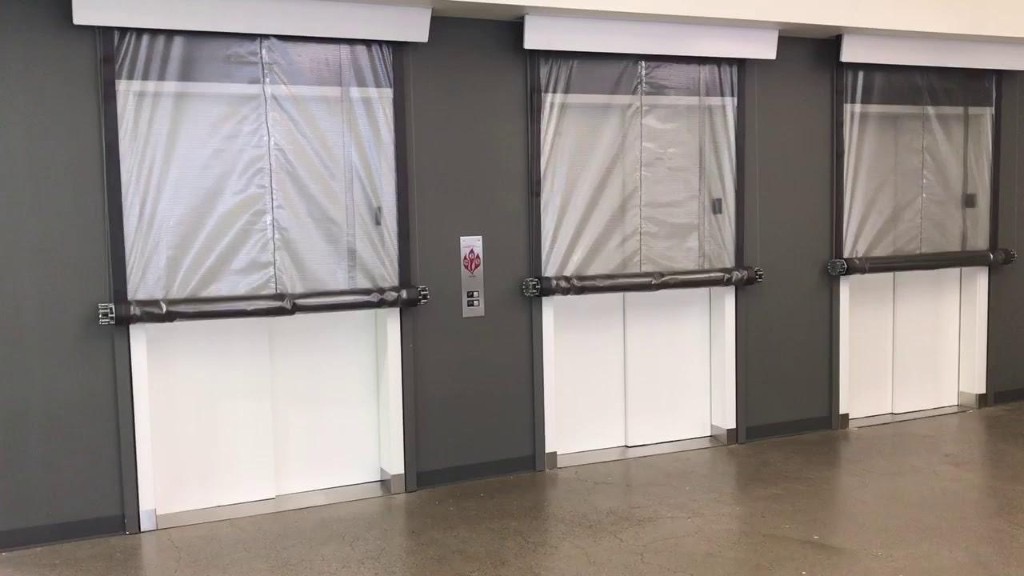
This question comes up constantly in the field, and the answer is clear in the code. The problem is that a lot of buildings aren't wired that way. Not because of a legitimate disagreement about how it should work, but because the people programming the system didn't fully understand what the code requires.
I've seen buildings where curtains drop on every floor the moment a fire alarm activates. I've seen AHJs request zone-based activation. I've seen elevator inspectors, fire marshals, and building inspectors all show up to the same project with different expectations.
The code hasn't changed. Here's what it says and why it matters.
What ASME A17.1 Actually Requires
The International Building Code calls out smoke-protective curtain assemblies under Section 3006.3. That section requires compliance with ASME A17.1, Section 2.11.6.3. That's the elevator safety code's specific requirements for additional doors and devices used in lieu of an enclosed lobby. This language has been in place for roughly the past 15 to 20 years.
Section 2.11.6.3 covers five specific requirements for smoke doors and curtains at elevator entrances. Here they are:
(a) The additional door or device shall comply with the building code.
(b) The additional door or device, in any position, shall not interfere with the operation of the elevator. This means smoke curtains cannot obstruct access to hall call buttons, firefighter emergency operation key switches, or the view of direction lanterns or position indicators when the curtain is not deployed.
(c) The additional door or device shall not interfere with the fire-resistance rating and operation of the hoistway entrance. Direct or mechanical attachment to hoistway doors or frames is not permitted unless the curtain and hoistway entrance are listed as a complete assembly by a certifying organization.
(d) Additional doors or devices in the closed position shall not prevent firefighters from visually observing the elevator landing when the elevator hoistway door is no more than one-quarter open. This is the vision lite requirement. More on that below.
(e) Additional doors or devices shall be permitted to be deployed only at those hoistway openings where fire alarm initiating devices used to initiate Phase I Emergency Recall Operation associated with that elevator have been activated.
Item (e) is the one that answers the question directly. Curtains deploy only where the local fire alarm initiating devices have activated. Not building-wide. Not in zones. Locally.
Worth noting: Wisconsin has actually deleted item (e) by state amendment, which means in that jurisdiction the local-only requirement does not apply. That's the kind of state-level variation worth checking before you commission a system.
Why Local Activation Is the Right Answer
When a fire alarm pulls in a building, the elevators do not automatically shut down. What sends an elevator into Phase I recall is the local smoke detector at that elevator landing. That detector activates, the elevator goes to the primary or secondary recall floor, and it stays there. Firefighters then take over in Phase II, insert their key into the car, and control the elevator manually.
The firefighting protocol in a multi-story building is to take the elevator to one or two floors above or below the fire floor, exit, walk down the stairwell to the standpipe and communication equipment, and stage from there.
If every curtain in the building drops the moment a building alarm activates, you've created an obstacle at floors that have no smoke. The elevator is still moving. Firefighters using it in Phase II are now dealing with deployed curtains on clear floors while trying to move personnel and equipment in an active fire event.
The curtains are supposed to come down where the smoke is. As smoke migrates up through the shaft, which acts as a chimney, the local detector at each floor picks it up and the curtain at that floor deploys. That's the system working the way it was designed.
The Zone Activation Problem
Some AHJs, particularly on larger buildings, have required zone-based activation, where a group of floors drops together rather than individually. On a ten-story building you might see floors ten through eight as one zone, seven through five as another, four through two as a third.
I understand the instinct. It feels like extra protection. But it still misses what local activation is designed to do, and it doesn't align with what 2.11.6.3(e) requires.
One note on the first floor: in a fully sprinklered building, which any ten-story building is going to be, elevator smoke protection is typically not required at the floor of exit discharge. That's a separate conversation, but it's why the first floor often drops out of this discussion entirely.
Who Gets This Wrong and Why
When curtains are programmed to drop on every floor simultaneously, the fire alarm contractor owns that. They're typically a sub under the electrical contractor, and they're the ones wiring the trigger logic into the fire alarm control panel.
The problem is this error can survive inspections. Three different inspectors usually take a pass at elevator smoke curtains: the elevator inspector, the building code inspector, and the fire marshal. Any one of them should catch simultaneous all-floors deployment and flag it. Not all of them do.
When the GC gets the certificate of occupancy with curtains programmed incorrectly, correcting it becomes the GC's problem, even though the programming was done by the fire alarm sub.
What the Curtain Provider Should Do
If you're a curtain provider and you see the curtains being programmed to drop on all floors simultaneously, don't let it go. Generate an RFI. Document in writing that the current programming does not comply with ASME A17.1, Section 2.11.6.3, and route it through proper channels. If the decision is made to keep it that way over your objection, at least the record shows you raised it.
You're not the one programming the fire alarm. But your name is on the curtain submittal, and you'll be in the room when the inspector asks why these curtains dropped on every floor.
The Vision Lite Requirement
Item (d) of 2.11.6.3 deserves a closer look. When a curtain is deployed and a firefighter is operating the elevator in Phase II, they need to be able to look out onto the landing and see whether it's safe to exit before the hoistway doors open more than 25% of their travel. That's why every compliant elevator smoke curtain requires a vision lite, a transparent or translucent panel built into the curtain fabric that allows visual observation of the landing.
A solid curtain with no vision panel does not meet this requirement. It's not a design preference or an upgrade. It's a code requirement tied directly to firefighter safety, and it's been part of A17.1 for the same reason the rest of this section exists: the curtain is a tool for people operating in a live fire event, not just a passive barrier that deploys and sits there.
— John, The Smoke Curtain Guy